Can Pro Bono Support Bone Density and Strength in Long COVID and ME/CFS?
March 6, 2026
Pro BonoBone HealthLong COVID
Share:
Disclaimer: The information provided here is for educational purposes only and is not intended as medical advice. It should not be used to diagnose, treat, cure, or prevent any medical condition. Instead, use it as a starting point for discussion with your healthcare provider. Always consult with a qualified healthcare provider before starting any new medication, supplement, device, or making changes to your health regimen.
Months or even years after an initial SARS-CoV-2 infection, many individuals continue to fight a complex web of debilitating symptoms known as Long COVID. While the medical community initially focused heavily on the respiratory, cardiovascular, and neurological impacts of the virus, a silent but profound complication has emerged in the background: accelerated bone density loss. For patients living with Long COVID, myalgic encephalomyelitis/chronic fatigue syndrome (ME/CFS), and dysautonomia, the combination of systemic inflammation, prolonged immobility, and physiological stress creates a perfect storm for skeletal degradation. When your daily reality involves navigating severe post-exertional malaise (PEM) and debilitating fatigue, worrying about the structural integrity of your bones can feel incredibly overwhelming and deeply frustrating.
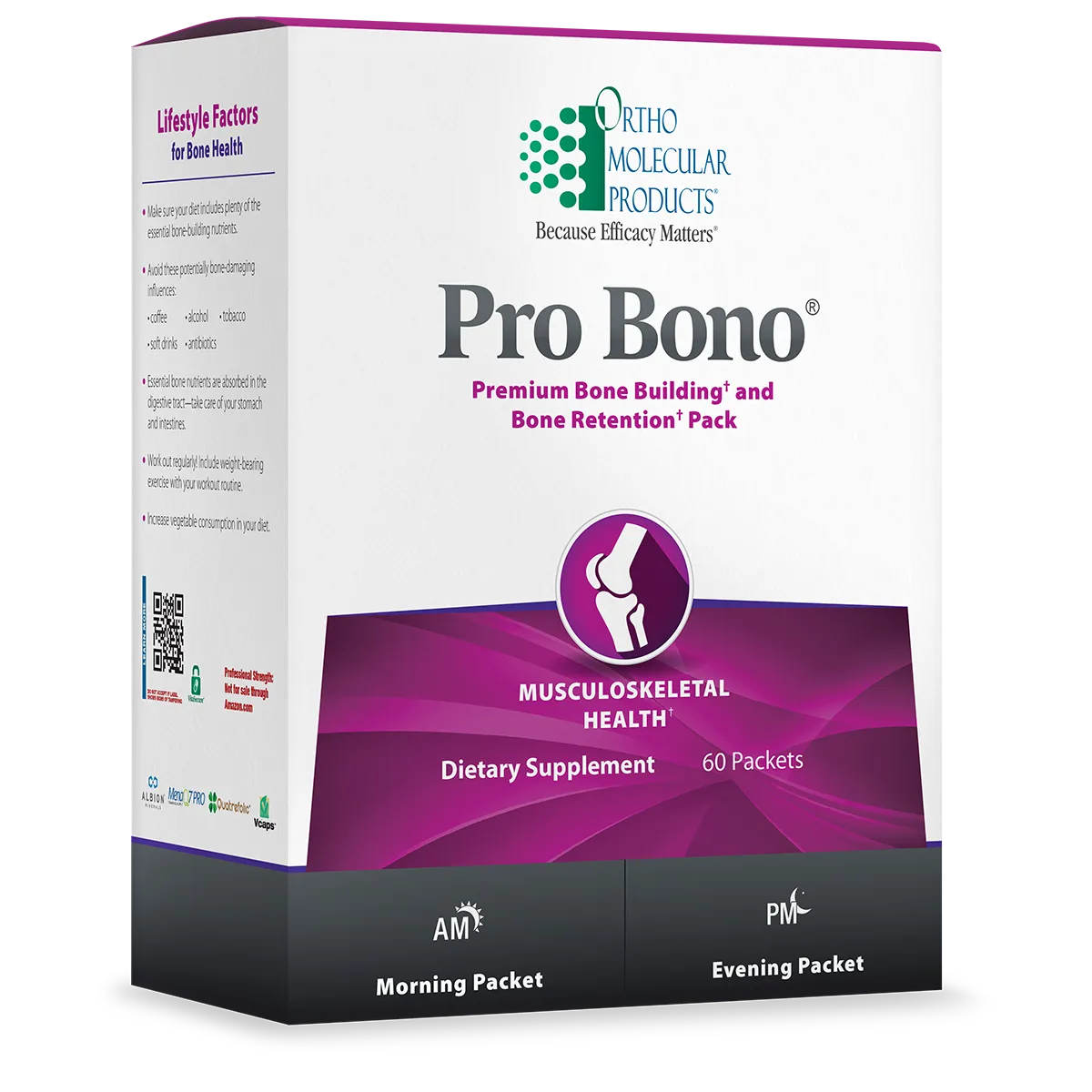
However, emerging research in the field of "osteovirology" is shedding light on exactly how these complex chronic conditions disrupt bone remodeling, and more importantly, how targeted nutritional interventions can help. Pro Bono by Ortho Molecular Products is an advanced, comprehensive bone-building protocol specifically designed to address these underlying mechanisms. By utilizing a unique AM/PM delivery system and providing highly bioavailable forms of strontium, calcium hydroxyapatite, vitamin K2, and magnesium malate, Pro Bono aims to restore the delicate balance between bone formation and bone resorption. In this article, we will explore the intricate biochemistry of bone health, how chronic illness disrupts it, and how the specific ingredients in Pro Bono can support skeletal strength and long-term resilience.
TL;DR
Chronic conditions like Long COVID and ME/CFS may accelerate bone density loss due to inflammation and immobility.
Pro Bono is a targeted AM/PM supplement protocol designed to support bone remodeling and skeletal strength.
It provides highly bioavailable minerals like strontium and calcium hydroxyapatite to support bone formation.
Always consult your doctor before starting high-dose supplements, especially regarding cardiovascular health and DXA scans.
What is Pro Bono?
The Foundation of Skeletal Integrity
To understand how Pro Bono works, we must first understand the dynamic nature of human bone. Far from being a static, lifeless scaffolding, the skeleton is a highly active, living tissue that undergoes continuous remodeling throughout your entire life. This lifelong process is governed by a delicate cellular dance between two primary types of bone cells: osteoclasts and osteoblasts. Osteoclasts are specialized macrophages responsible for bone resorption; they secrete acids and enzymes that break down old, micro-damaged bone tissue and release its stored minerals into the bloodstream. Following this clearance, osteoblasts move into the microscopic cavities left behind and secrete a flexible protein matrix, primarily composed of Type I collagen.
Once the osteoblasts have laid down this collagen foundation, the process of bone mineralization begins. The body pulls calcium, phosphorus, and other trace minerals from the blood and crystallizes them around the collagen matrix, forming a hard, dense mineral known as hydroxyapatite. In a healthy, youthful body, the activity of osteoclasts and osteoblasts is perfectly coupled, meaning the amount of bone removed is exactly equal to the amount of new bone formed. This equilibrium maintains optimal Bone Mineral Density (BMD) and skeletal strength. However, when this ratio is disrupted—whether by aging, hormonal changes, or chronic systemic inflammation—osteoclast activity begins to outpace osteoblast activity, leading to a net loss of bone mass, structural fragility, and eventually osteopenia or osteoporosis.
The AM/PM Protocol and Nutrient Synergy
Pro Bono is not a standard, single-pill calcium supplement. It is a comprehensive, clinical-grade protocol designed to provide the exact micronutrients required for every step of the bone remodeling process. Recognizing that certain minerals chemically compete for absorption in the gastrointestinal tract, the formulation utilizes a highly specific AM and PM packet delivery system. This strategic separation ensures that the body can maximally absorb and utilize each ingredient without interference, mimicking the natural physiological rhythms of mineral metabolism. By providing a full spectrum of foundational micronutrients alongside targeted bone-supportive compounds, Pro Bono is formulated to replace the need for an additional daily multivitamin while aggressively targeting skeletal health.
The formulation includes a robust blend of vitamins and minerals, including Vitamins A, C, D3, E, a complete B-complex, iodine, zinc, selenium, copper, manganese, chromium, molybdenum, and boron. However, the true clinical power of the protocol lies in its heavy-hitting primary ingredients: strontium citrate, calcium hydroxyapatite, vitamin K2 (as MK-7), and magnesium malate. Each of these components plays a distinct, synergistic role at the molecular level, from physically stabilizing the hydroxyapatite crystals to acting as biological "traffic cops" that direct minerals specifically into the bone tissue rather than allowing them to calcify in soft tissues or arteries.
Balancing the Osteoclast-to-Osteoblast Ratio
The ultimate goal of the Pro Bono protocol is to restore an optimal osteoclast-to-osteoblast ratio. Traditional pharmaceutical interventions for bone loss, such as bisphosphonates, work almost exclusively by poisoning or inducing apoptosis (cell death) in osteoclasts. While this successfully stops bone breakdown, it also severely blunts the formation of new bone, leading to older, potentially more brittle bone tissue over time. Pro Bono takes a dual-action approach, providing the raw materials and signaling molecules necessary to actively stimulate osteoblast differentiation and collagen synthesis, while simultaneously modulating the overactive inflammatory pathways that drive excessive osteoclast activity. This comprehensive approach supports the creation of new, structurally sound bone matrix.