Can Cortisol Calm Support the HPA Axis in Long COVID and ME/CFS?
March 5, 2026
Cortisol CalmLong COVIDME/CFS
Share:
Disclaimer: The information provided here is for educational purposes only and is not intended as medical advice. It should not be used to diagnose, treat, cure, or prevent any medical condition. Instead, use it as a starting point for discussion with your healthcare provider. Always consult with a qualified healthcare provider before starting any new medication, supplement, device, or making changes to your health regimen.
Months or even years after a viral infection, many individuals living with complex chronic conditions find themselves trapped in a paradoxical state of exhaustion. You might feel profoundly, bone-wearily fatigued, yet simultaneously "wired," anxious, and unable to achieve restful sleep. This frustrating combination is a hallmark of conditions like Long COVID, myalgic encephalomyelitis/chronic fatigue syndrome (ME/CFS), and dysautonomia. When your body's central stress response system—the hypothalamic-pituitary-adrenal (HPA) axis—becomes dysregulated, it can feel as though your internal thermostat is permanently broken, leaving you vulnerable to severe crashes, systemic inflammation, and debilitating cognitive dysfunction.
For patients navigating these invisible illnesses, standard medical advice often falls short. You may be told to simply "reduce stress" or "get more sleep," which feels impossible when your nervous system is locked in a state of sympathetic overdrive. This is where targeted, science-backed nutritional support becomes a vital piece of the management puzzle. In this comprehensive guide, we will explore the intricate biology of the HPA axis, how viral infections disrupt it, and whether a specialized adaptogenic formulation like Cortisol Calm can help restore balance, alleviate hyperarousal, and support cognitive clarity for those battling post-infectious chronic illness.
TL;DR
Chronic illness often disrupts the HPA axis, causing a "wired and tired" state of exhaustion and hyperarousal.
Cortisol Calm uses adaptogens like ashwagandha and Rhodiola to help restore natural stress hormone rhythms.
Ingredients like L-theanine and Magnolia bark may help support relaxation, better sleep, and cognitive clarity.
Always consult your healthcare provider before starting new supplements, especially if taking other medications.
What is Cortisol Calm?
To understand how Cortisol Calm works, we must first examine the biological system it is designed to support: the hypothalamic-pituitary-adrenal (HPA) axis. In a healthy body, the HPA axis serves as the central command center for your stress response, energy metabolism, and immune regulation. When you encounter a physical or psychological stressor, the hypothalamus in your brain releases corticotropin-releasing hormone (CRH). This hormone travels a short distance to the pituitary gland, prompting it to secrete adrenocorticotropic hormone (ACTH) into the bloodstream. ACTH then acts as a messenger, traveling down to the adrenal glands sitting atop your kidneys, signaling them to produce and release cortisol.
Cortisol is often vilified as the "stress hormone," but it is actually a vital, life-sustaining molecule. It regulates blood sugar, modulates the sleep-wake cycle (the diurnal rhythm), and acts as the body's primary endogenous anti-inflammatory agent. In a perfectly functioning system, cortisol levels peak in the early morning to help you wake up and gradually decline throughout the day, reaching their lowest point at midnight to allow for deep, restorative sleep. Furthermore, a healthy HPA axis relies on a negative feedback loop; once enough cortisol is circulating, it signals the brain to stop producing CRH and ACTH, effectively turning off the stress response and allowing the nervous system to return to a state of calm homeostasis.
However, when the body is subjected to chronic, unrelenting stress—whether from a severe viral infection, chronic pain, or long-term psychological trauma—this elegant feedback loop can break down. The HPA axis may become blunted or hyper-reactive, leading to erratic cortisol secretion. This dysregulation is a primary driver of the "wired and tired" sensation, where the body is too exhausted to function normally but too chemically stimulated to rest.
The term "Cortisol Calm" might suggest that the goal is simply to crush or eliminate cortisol, but this is a misconception. For many patients with Long COVID or ME/CFS, cortisol levels are actually lower than normal, not higher. The true therapeutic goal is modulation and restoration of the natural diurnal rhythm. This is achieved through the use of adaptogens—a unique class of botanical compounds that increase the body's resistance to stress and help it return to a state of equilibrium, regardless of whether the system is overactive or underactive.
Adaptogens work at the cellular level to buffer the HPA axis against the damaging effects of biological stress. They do not act like pharmaceutical stimulants or sedatives, which force the body into a specific state. Instead, research suggests that adaptogens act as "stress mimetics," mildly stimulating the body's protective mechanisms so that when a real stressor occurs, the physiological response is blunted and manageable. By pairing these adaptogens with specific neuromodulating amino acids and vitamins, a comprehensive supplement can address multiple facets of nervous system dysfunction simultaneously.
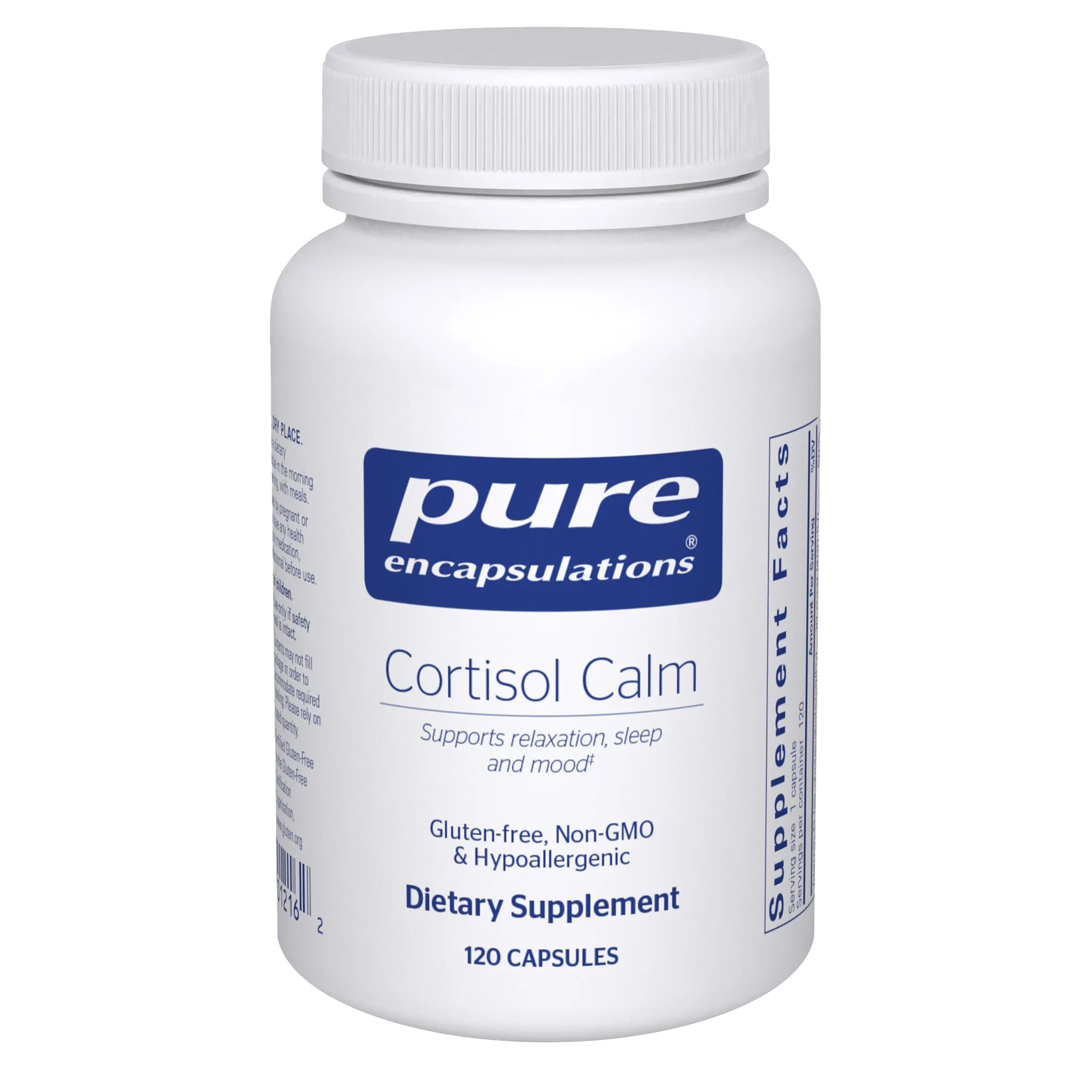
Cortisol Calm by Pure Encapsulations is a targeted, synergistic blend of five highly researched ingredients designed to maintain a healthy stress response. It combines two potent adaptogenic botanical extracts—Sensoril® ashwagandha and Rhodiola rosea—with the neuro-calming properties of Magnolia officinalis bark and the amino acid L-theanine. Finally, it includes a small but targeted dose of Vitamin D3.
Unlike generic stress supplements that rely on single ingredients, this formulation is designed to address the stress response from multiple biological angles. It targets the adrenal glands to modulate cortisol output, the brain's neurotransmitter receptors to promote alpha brain waves, and the cellular mitochondria to combat physical fatigue. For patients managing the complex, multi-systemic symptoms of post-viral illness, this multi-targeted approach is often necessary to break the cycle of chronic hyperarousal and exhaustion.